
Factors Driving the Market Value of the 1918 Wheat Penny
The market 1918 Wheat penny value is determined by a set of technical characteristics recorded during expert evaluation.
This issue belongs to the World War I period imposing certain restrictions on the quality of used alloys and the intensity of die operation.
Studying pricing requires analyzing mintage statistics, the physical condition of the metal, and the production specifics of individual US mints.
Coin production followed the standards established for the Lincoln Cent series.
Composition: Alloy of copper (95%), tin, and zinc (5%).
Weight: 3.11 grams.
Diameter: 19.05 millimeters.
Edge Type: Plain.
Compliance with these parameters is verified during authenticity validation excluding the possibility of counterfeits made from irrelevant alloys.
Mintage Distribution by Mint Facility
Total production exceeded 450 million units distributed among three US Mint production sites.
Mint Facility | Mint Mark | Mintage Volume (pcs) | Share of Total Output (%) |
Philadelphia | None | 370,614,634 | 81.8% |
Denver | D | 47,830,000 | 10.5% |
San Francisco | S | 34,680,000 | 7.7% |
The Philadelphia mint output is dominant making common examples of this mint the most accessible on the market.
Grading as the Primary Price Driver
Condition is assessed using the 70-point Sheldon scale directly correlating with market value.
Circulated Grades
Coins remaining in circulation for long periods lose relief detail reducing their attractiveness for investment portfolios.
Good-4 (G): Heavy wear showing letters merging with the rim, price ranges from 0.15–0.35 USD.
Fine-12 (F): Displaying basic outlines of Lincoln’s hair and wheat lines, value reaches 0.75–1.20 USD.
Very Fine-20 (VF): Preservation of clear lettering keeps the price within 2.00–4.00 USD.
Extremely Fine-40 (XF): Wear affecting only the highest points of the relief raises the value to 7.00–12.00 USD.
Mint State (MS) Condition
Examples lacking traces of circulation demonstrate a sharp price increase when moving between adjacent grades.
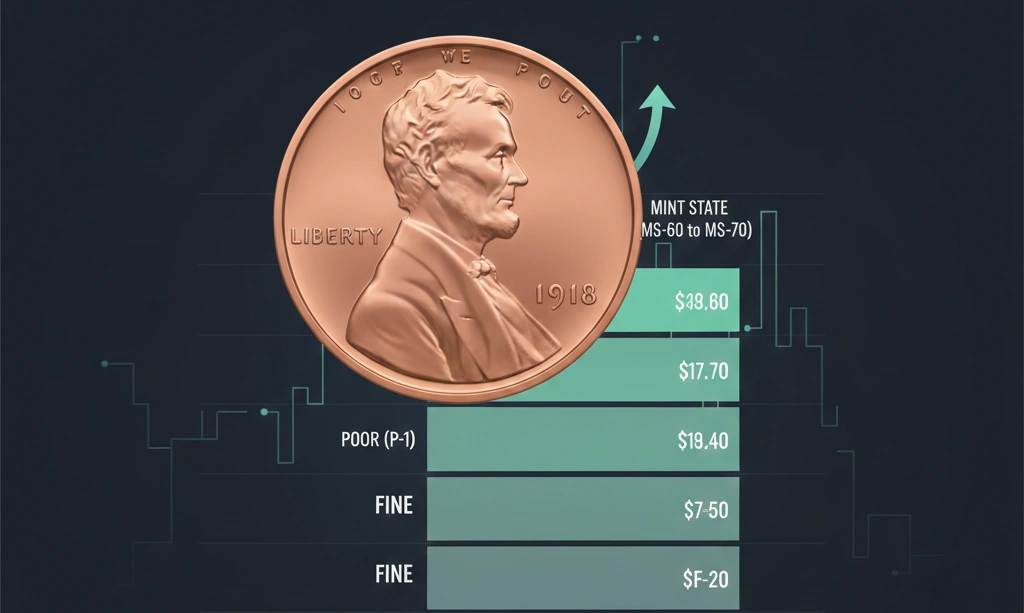
MS-63: Containing moderate contact marks, market price sits at 45–65 USD.
MS-65: High detail and presence of mint luster increase the price to 180–320 USD.
MS-67: Exceptional rarity valued at 5,000 USD and above.
Color Designations and Their Price Impact
For 1918 copper coins, the preservation of original metal color is a critical factor.
Brown (BN): The surface is completely oxidized having lost its mint luster.
Such coins carry a minimal price premium.
Red-Brown (RB): Retaining between 5% and 95% of the original copper color.
The price is 30–50% lower compared to fully red counterparts — you can easily check it with the free coin identifier app.
Red (RD): Retaining over 95% of bright luster guaranteeing maximum market value.
Transitioning from RB to RD in MS-65 grade can increase the coin's price by 150%.
Price Change Statistics and Market Dynamics
Investment analysis shows steady value growth for high-quality coins.
Average Annual Growth (MS-65 RD): 8.4% over the last 15 years.
Price Drop Due to Oxidation: Losing Red (RD) status and moving to Brown (BN) reduces the asset value by 65% instantly.
Correlation with Copper Prices: The value of low-grade coins (G-VG) is tied to metal weight showing fluctuations of 1–3% per year following commodity markets.
1918-D (Denver) Minting Characteristics
Coins with the "D" mark are valued higher than Philadelphia issues due to lower mintage and production cycle specifics.
Detailed examination of 1918-D often reveals a weak strike in the central part of the relief.
Examples featuring full wheat ear detail (Full Strike) sell at a 25% premium over the base grade.
Record Price: A 1918-D coin graded MS-66 RD sold for 14,950 USD at auction in 2007.
1918-S (San Francisco) Minting Characteristics
The San Francisco issue is considered the most difficult to find in "Red" condition.
High humidity in the region contributed to accelerated copper darkening occurring before coins even entered circulation.
Possessing original red color automatically places a 1918-S coin into the category of investment rarities.
Record Price: In 2005, a 1918-S MS-66 RD specimen realized 21,850 USD.
Production Defects and Mint Errors
Technical failures during the pressing process create unique units with values independent of standard tables.
Off-center Strike: Shifting the design by 50% while retaining the date increases the price by 150–300 USD.
Double Strike: The presence of a secondary outline on letters or digits adds 500–1,200 USD depending on prominence.
Die Cracks: Thin raised lines on the metal surface add 10–50 USD to the price without being an official variety.
Factors Decreasing Value
Irreversible damage exists excluding a coin from top-tier collectible assets.
Cleaning: Mechanical or chemical action aimed at removing patina strips the coin of numismatic value reducing the price by 80–90% of market rate.
Environmental Damage: Deep metal corrosion makes a coin ineligible for numeric grading.
Scratches and Bag Marks: Large defects on Lincoln’s face lower the final grade by 2–3 steps but double-check it with the coin checker app.
Data based on extrapolation of auction sales for the 2010–2023 period.
Preservation Category | Price Growth Forecast (%) | Liquidity Level |
Circulated (G-XF) | 12% | High |
MS-63 BN/RB | 35% | Medium |
MS-65 RD | 78% | High |
MS-67 RD | 145% | Low (Rare offerings) |
Influence of Certification
Holding a slab from leading grading companies is a mandatory requirement for selling coins valued above 100 USD.
A certified coin sells on average 40% faster than a "raw" specimen of similar quality.
Grading service costs ranging from 25–60 USD make sending coins below MS-60 grade impractical.
The value of the 1918 Wheat Penny follows strict mathematical patterns relying on surface condition and color rarity.
Analysis indicates that maximum financial potential is concentrated in Denver and San Francisco specimens retaining original red luster.
Steady demand for high-grade samples ensures capital preservation considering the limited supply available on open auction platforms.