
Why the 1941 Jefferson Nickel Still Holds Collector Attention
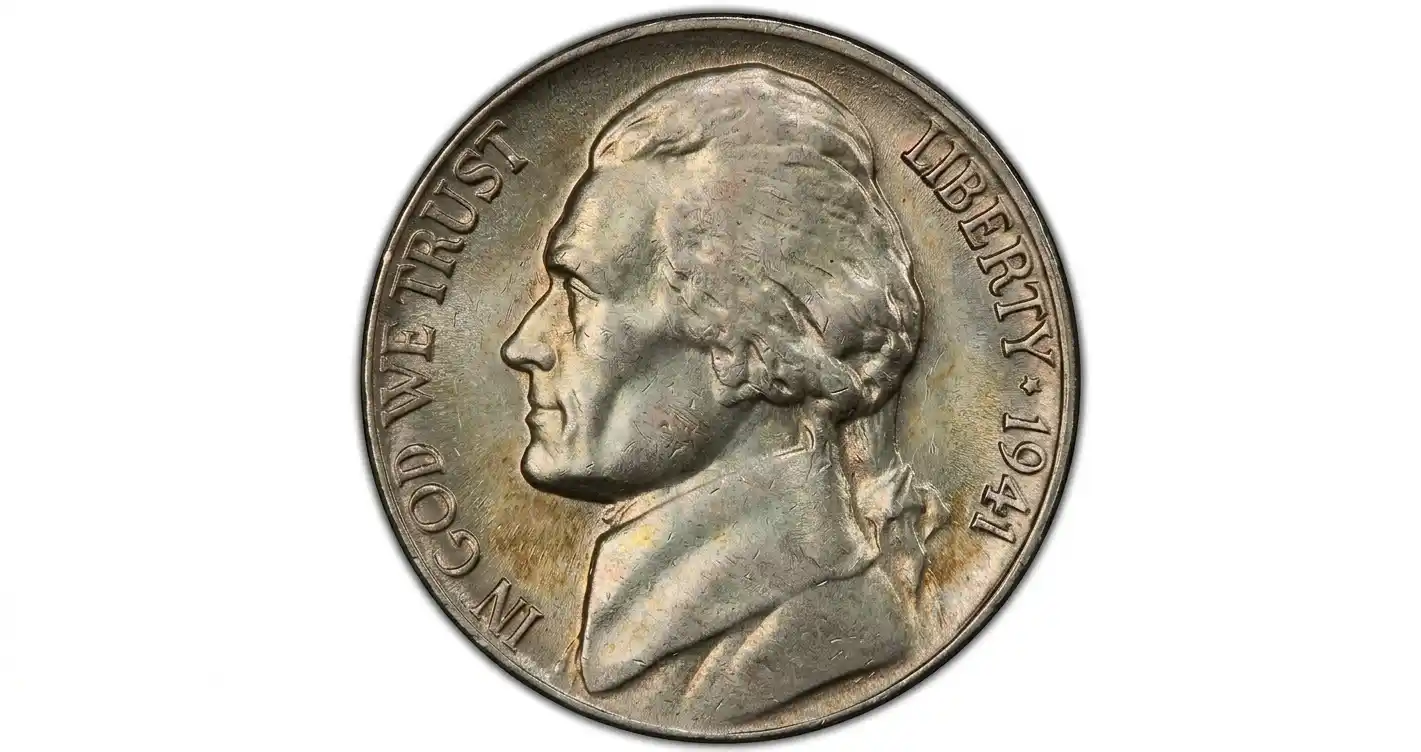
Design stability does not guarantee uniformity in the 1941 nickel value.
Production of five-cent pieces in 1941 occurred just before the United States entered World War II.
Parameter | Value |
Mass | 5.00 grams |
Composition | 75% Copper, 25% Nickel |
Diameter | 21.21 mm |
Edge Type | Plain |
Designer | Felix Schlag |
Production Statistics by Mint Location
Total output volume exceeded the figures of previous years.
Volume factors directly influence modern market demand.
Mintage distribution:
Philadelphia — 203,265,000 units
Denver — 43,540,000 units
San Francisco — 43,445,000 units
Philadelphia (No Mint Mark)
Producing the highest number of units, this facility ensured mass availability.
High mintage levels result in easy access to coins in average condition.
Specimens reaching the MS67 grade remain extremely scarce.
Denver (D Mark)
Denver's output accounted for approximately 21% of the total yearly production.
Coins originating from this mint often demonstrate a sharper strike compared to Philadelphia counterparts.
Possessing full steps on the reverse side significantly increases the final price.
San Francisco (S Mark)
Mintage volume stays comparable to Denver's output levels.
The S mark traditionally attracts attention due to regional distribution specifics.
Many coins from this year exhibit microscopic die defects.
Market Value Dynamics
The numismatic market shows steady price growth for high-quality grades.
Below is the value dynamic for specimens in MS66 Full Steps condition.
2024 year price: 185 $ per unit.
2025 year price: 210 $ per unit.
2026 year current worth: 245 $ per unit.
2027 year projected value: 280 $ per unit.
Annual percentage growth averages approximately 12-15%.
This trend results from the gradual removal of top-tier samples from general circulation.
Price Formation Factors
Surface condition → baseline evaluation.
Full Steps presence → premium markup.
Absence of mechanical damage → liquidity preservation.
Classification of Minting Defects and Errors
Minting errors from 1941 represent a distinct market segment.
Every anomaly has a clear record in specialized catalogs.
Double Die Reverse (DDR)
Elements on the back side of the coin appearing doubled.
Most visible on the inscriptions E PLURIBUS UNUM and MONTICELLO.
Price for such a specimen in MS64 grade sits around 350 $.
Off Center
Images shifting relative to the center of the planchet.
Shift percentage determines the final worth.
10% shift → 40 $.
50% shift → 150 $.
90% shift → 300 $.
Repunched Mintmark (RPM)
Repeated application of the mint facility letter.
Found primarily on coins from Denver and San Francisco.
Value impact varies from 20 $to 100$ depending on doubling intensity.
Die Cracks
Raised thin lines appearing on the coin field due to equipment fatigue.
Cracks occurring during prolonged machinery operation often look like fine wires.
Massive small cracks do not generate significant added value.
Full Steps Category as a Quality Indicator
The term Full Steps describes the strike clarity of the Monticello estate stairs.
Obtaining this category requires five or six completely separated lines.
Weak strike → missing lines → baseline worth.
Strong strike → sharp lines → Full Steps status → tenfold price increase.
Record Sales Figures
Cases of coins selling at extremely high prices remain documented.
Heritage Auctions 2013: 1941-S Jefferson Nickel MS68 Full Steps sold for 6,463 $.
Stack's Bowers 2021: 1941-D Jefferson Nickel MS68 Full Steps sold for 9,000 $.
Current 2026 estimates suggest these top-tier coins could exceed 12,000 $ at auction.
Grading Impact on Liquidity
Professional certification by specialized agencies serves as a mandatory requirement for high-value deals.
PCGS and NGC agencies dominate this sector.
Coin without a certificate → risk of forgery or hidden cleaning.
Coin in a slab → confirmed grade and environmental protection.
Grade | Average price |
MS64 | 15 $ |
MS65 | 30 $ |
MS66 | 85 $ |
MS67 | 600 $ |
The sharp price jump between MS66 and MS67 occurs because of the exponential decrease in surviving specimens.
Metal Composition and Features
Using a standard alloy in 1941 prevented corrosion processes typical for steel coins of that era in other countries.
Copper provides the necessary ductility during the minting process.
Nickel grants the required hardness and a characteristic metallic luster.
Alloy chemical stability allows coins to retain fine details for decades.
Oxidation Process
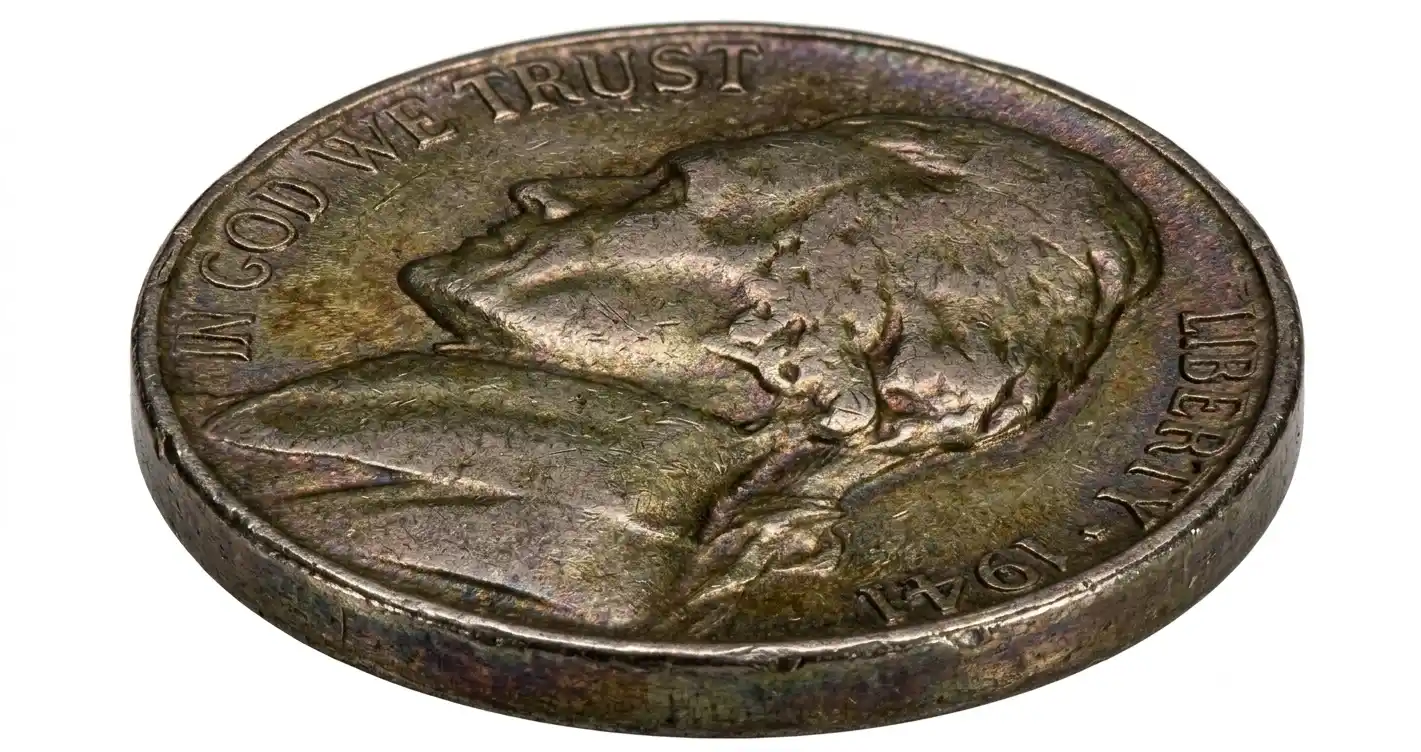
Storing coins in high humidity environments causes copper to react with the surroundings.
Dark patina formation → change in visual characteristics.
Natural rainbow toning can increase auction value by 20-30%.
Artificial darkening or mechanical cleaning → complete loss of numismatic value.
Comparison with 1941 Proof Issues
The Philadelphia Mint produced a limited batch of improved quality coins.
Proof mintage reached 18,720 units.
These items were intended exclusively for collector sets.
Production technology involved a double strike using polished dies.
Result → mirror-like fields and frosted relief.
Proof Value Trends
2022 year worth: 135 $.
2024 year worth: 160 $.
2026 year current worth: 195 $.
Limited supply ensures a consistent increase in collector demand.
Historical Conditions Affecting Output
Preparing industry for military needs required resource optimization.
Mints operated in three shifts to provide the economy with sufficient cash.
Increasing striking speed often led to rapid equipment wear.
Worn dies → defects appearing on later batches of coins.
Finding early 1941 strikes with sharp details remains a priority task.
Methodology for Rare Specimen Evaluation
Accurate determination of a coin's potential involves a comprehensive approach.
Visual inspection using a free coin value lookup app.
Magnetic testing to exclude fakes.
Weighing against the 5.00 gram standard.
Analyzing line clarity in key areas.
Weight discrepancies exceeding 0.2 grams might indicate falsification or heavy wear.
Weight | Status |
5.00 g | Reference |
4.95 - 5.05 g | Acceptable tolerance |
< 4.80 g | Heavy wear or counterfeit |
Market Perspectives in 2026
Numismatic investments serve as a method for asset diversification.
The 1941 Jefferson Nickel demonstrates lower volatility compared to precious metals.
Demand for high-grade slabbed coins consistently exceeds market supply.
Decreasing numbers of available auction lots → rising starting prices.
Growing investor bases lead to the depletion of quality material from the market.
Purchasing Selection Algorithm
Analyzing auction records from the last 3 years.
Selecting coins certified by leading laboratories.
Prioritizing specimens with D or S marks.
Mandatory verification of no mechanical cleaning traces.
Technological Innovations of 1941
Implementing new die hardening methods allowed for increased service life.
Most 1941 coins possess relatively high detail even in lower grades.
Comparative analysis with the 1938 issue shows progress in the clarity of small portrait elements.
Hair texture and clothing outlines appear more deeply defined.
Image Geometry
Inscription placement relative to the rim remained unchanged.
Letter thickness in the word LIBERTY stayed standardized.
Any font deviations suggest the use of unofficial minting equipment.
Scarcity Assessment via Sheldon Scale
Standard numerical values from 1 to 70 apply to the 1941 coin.
Most circulating coins fall within the VG8 - VF20 range.
Uncirculated coins begin at the MS60 mark.
MS68 specimens remain unique and practically never appear in open sales.
Grade Frequency (Population Statistics)
Grade MS65 — found frequently.
Grade MS66 — found regularly.
Grade MS67 — found rarely.
Grade MS68 — exceptional rarity.
Specifics of the Coin Reverse
The Monticello estate image requires special attention during expertise.
The building dome must have sharp borders.
Windows and doors must stay distinguishable without powerful optics.
Absence of column merging with the main facade indicates high-quality minting.
Stair Detailization
6 steps → highest quality category.
5 steps → high quality category.
Merged steps → standard execution.
Price differences between 5 and 6 steps can reach 50%.
Comparative Mintage Table 1940-1942
Year | Total Mintage (millions) | Composition |
1940 | 259.7 | Copper/Nickel |
1941 | 290.2 | Copper/Nickel |
1942 | 154.5 | Silver/Copper/Manganese |
Increasing mintage in 1941 resulted from rising internal trade turnover.
Subsequent mintage drops in 1942 relate to the technological shift toward the war alloy.
Guidelines for Storing Valuable Specimens
Preventing metal degradation requires maintaining a specific temperature regime and the coin identifier app free usage.
Storage in plastic capsules free of PVC.
Excluding direct contact with skin oils.
Using safes equipped with humidity control.
Exposure to sulfur-containing materials → rapid nickel corrosion.
Stable environment → preservation of investment appeal.